Nia Nixon

What does AI do to the social fabric of collaboration?

I investigate what AI does to how groups think, deliberate, and belong.

Research Infrastructure

The interdisciplinary lab and the experimental platform that anchor this research program.

TRAIL

Team Research & AI Integration Lab Platform

TRAIL is the empirical infrastructure that makes this research tractable — a platform for studying human–AI teaming in real group interactions. It supports controlled experiments on how AI's presence shapes communication, participation, and collective reasoning. Phase 1 deployed across four pilot studies through 2025; Phase 2, beginning in 2026, moves the work from diagnosis toward design. Developed with the LaLA Lab team, with technical leadership from PhD student Amin Samadi.

Visit TRAIL →

LaLA Lab

Language & Learning Analytics Lab

The Language and Learning Analytics Lab is the interdisciplinary group where this research program lives. We study how cognitive, social, and affective processes unfold through language in teams, and how AI's presence reshapes them. The lab develops methods and tools to make collaboration more effective, more inclusive, and better understood.

Visit LaLA Lab →

HAT Initiative

Human–AI Teaming Initiative

A growing community of researchers, students, and practitioners working on human–AI teaming. The initiative convenes workshops, talks, and collaborative events to grow shared inquiry around how AI is reshaping team dynamics — and what it would mean to design these systems well.

Visit HAT Initiative →

Why This Matters

AI is becoming a constant presence in how we collaborate — in classrooms, in workplaces, in civic life. Its most consequential effects are not on what individual people produce, but on the social fabric itself: the relational processes through which we think, deliberate, and belong together.

When AI enters a team, it does not simply assist. It shapes who speaks, who is heard, and whose ideas move forward. It bends the conversational space in ways most participants never notice — often without anyone trusting or deferring to it.

These effects accumulate. Groups that defer to AI on moral questions can lose the muscle of collective deliberation. Collaborators whose epistemic agency is narrowed by algorithmic curation struggle to negotiate divergent perspectives. Teams whose participation dynamics are shaped by AI design choices made without equity in mind can replicate existing hierarchies at scale.

The answer is not less AI. It is AI designed with explicit attention to these dynamics — systems that protect moral voice rather than suppress it, expand epistemic access rather than narrow it, and distribute participation rather than concentrate it.

News

Research Highlights

  • TRAIL Platform , A research platform for studying human–AI collaboration in real-time team environments. Now live and supporting its first collaborative studies on how AI teammates influence interaction, learning, and inclusion.
  • Group Communication Analysis (GCA) , Co-inventor of a U.S. patent introducing a computational framework for modeling socio-cognitive dynamics in team interactions.

In the Media

Upcoming

  • Jacobs Foundation Annual Meeting, Paris, France June 2026

    Participating in the Jacobs Foundation Annual Meeting to share ongoing work on children’s collaboration with AI and the future of inclusive human–AI learning environments.

  • AIED 2026, Seoul, South Korea June–July 2026

    Co-leading the workshop From Tools to Teammates II: Designing AI That Belongs, focused on the social and relational design of AI for collaborative learning.

  • Society for Text and Discourse, Charlotte, NC July 2026

    Invited keynote on human–AI collaboration, focusing on how AI participates in communication, learning, and team dynamics.

About me

Much of my work, and much of my excitement, comes back to a single question: what does AI do to the social fabric of collaboration? Most AI research asks how AI changes what individual people produce. I'm asking what AI does to people in relation to each other — to the relational processes through which we think, deliberate, and belong together.

My work sits at the intersection of cognitive science, learning science, computational discourse science, and human-AI interaction. I draw on these traditions to study collaboration as a multilevel phenomenon — attending to processes that unfold within individuals, processes that emerge across groups, and how each shapes the other — across time rather than in snapshots. This means tracing how interaction patterns evolve in teams and what they reveal about who participates, who is heard, and whose ideas move forward. The work is anticipatory by design: asking these questions while the phenomena are still emerging, before the field is forced to.

I am an Associate Professor in the School of Education at the University of California, Irvine, with a courtesy appointment in the Department of Cognitive Sciences. I direct the Language and Learning Analytics Lab (LaLA Lab), an interdisciplinary group studying how language, interaction, and AI shape collaboration. I also lead the development of TRAIL — the empirical infrastructure that makes this research tractable, a platform for studying human-AI teaming in real group interactions.

I am also the founding director of the MES-AI program at UC Irvine, a fully online master's designed to train the next generation of educational data scientists and AI leaders. The program connects learning science, AI, and analytics to real-world applications.

What collaboration looks like in a world where AI is part of every team will be shaped by decisions being made right now. The goal of this work is to make those decisions more honest, more equitable, and more grounded in evidence about what AI is actually doing to us when we work together.

The LaLA Lab

The Language and Learning Analytics Lab (LaLA Lab) is the interdisciplinary research group that conducts this work. We investigate how language, interaction, and AI shape learning, collaboration, and team cognition — and what shifts in those dynamics when AI is part of the conversation.

What We Study

  • Team communication and collaborative learning
  • Cognitive, social, and affective processes in interaction
  • Human–AI teaming and AI as a social actor in groups
  • Participation, belonging, and equity in collaborative settings

Current Directions

  • How AI's presence shapes the moral character of group deliberation and decision-making
  • How algorithmic systems shape epistemic agency and whose perspectives surface in collaboration
  • How AI redistributes — or fails to redistribute — participation, inclusion, and belonging in teams
  • Designing AI-supported environments for more equitable learning and work

How We Work

We take a theory-driven, empirically grounded approach drawing on computational discourse science, learning analytics, and experimental social science. Our analyses work at multiple levels — individual and group — and trace interaction across time rather than in snapshots. The work connects directly to real-world settings: classrooms, online learning environments, and organizational teams.

Lab Culture and Mentorship

The LaLA Lab is a collaborative, supportive environment where students take ownership of their research from early on. Lab members co-design studies, co-author publications, and contribute to a culture of shared expertise. We are committed to mentoring researchers who are intellectually curious, methodologically rigorous, and passionate about human-centered AI.

Interested in joining us? We welcome applications from PhD and master's students excited about the questions this work asks — about language, interaction, AI, and the social dynamics of collaboration. Please review the UCI School of Education graduate programs for application details, and reach out with questions about fit.

Research

My research investigates what AI is doing to the social fabric of collaboration — and what would have to change in the design of AI systems for that fabric to hold. The work moves across three connected areas of inquiry: how AI shapes the moral character of group deliberation, how it shapes whose perspectives and ways of knowing get heard, and how it redistributes — or fails to redistribute — participation and belonging in collaborative settings. The architecture below is the working map I use to think about how these areas relate, the mechanisms through which AI bends each, and the social contexts in which they unfold.
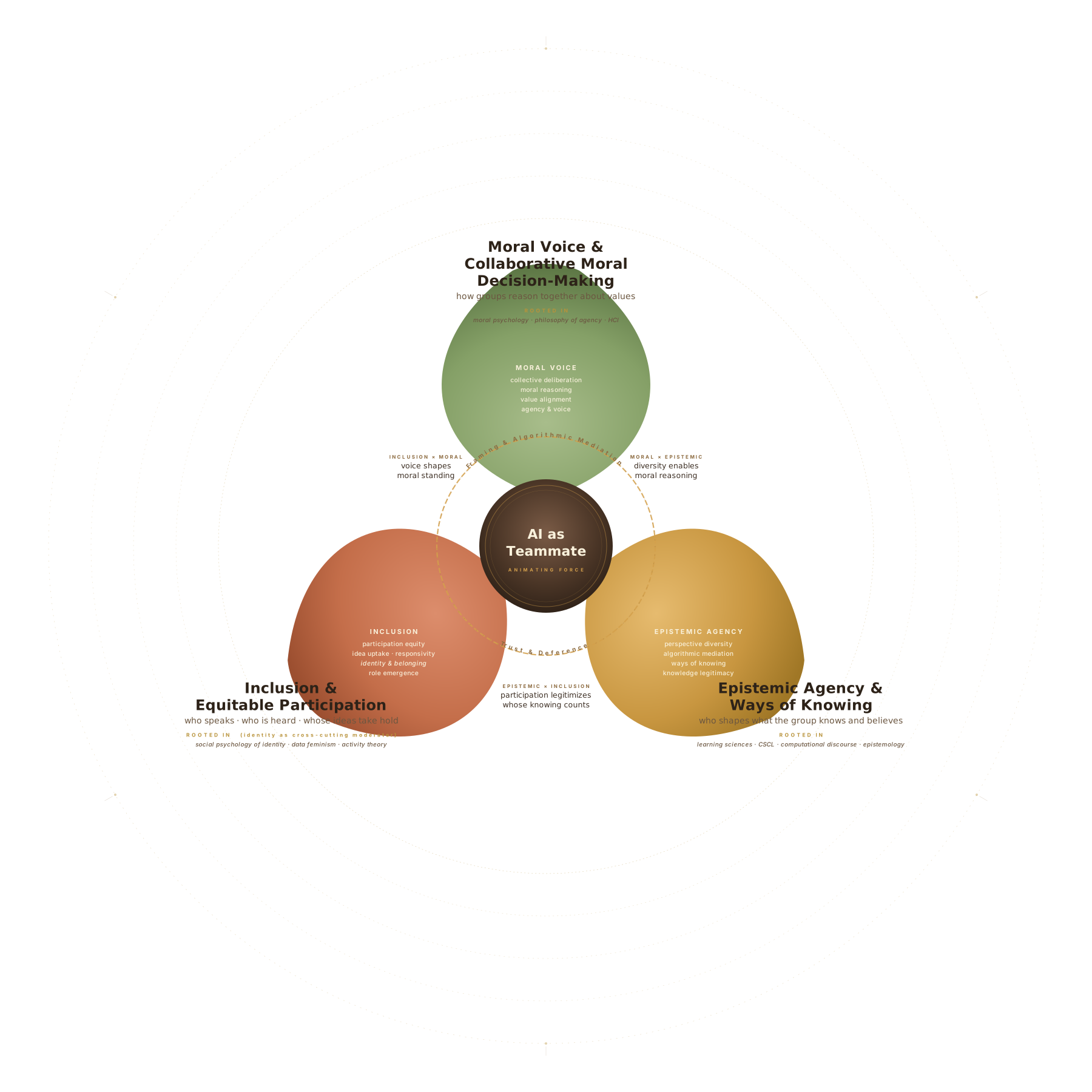
Three-petal architecture of Nia Nixon's research areas, threaded by mediating mechanisms, unfolding across nested social contexts from small groups to society.

Across nested contexts

  1. Small Groups & Teams
  2. Classrooms
  3. Workplaces
  4. Civic Spaces
  5. Society & Public Life

The architecture I use to think with — three areas of inquiry, threaded by mediating mechanisms, unfolding from teams to society.

Moral Voice & Collaborative Moral Decision-Making

Whether people retain the capacity to deliberate together on hard moral and ethical questions when AI is part of the conversation. Whether AI's presence shifts how groups reason about and prioritize human values, and whether it suppresses or amplifies individual moral voice within a group.

This is the newest area of the program. Active experimental work is underway at UCI (results April 2026) with a cross-cultural replication in Vienna (Summer 2026). Publications forthcoming.

Epistemic Agency & Ways of Knowing

Whether people maintain a sense of themselves as legitimate knowers, and whether AI expands or narrows the diversity of perspectives and ways of knowing that surface in collaborative settings. Who shapes what the group comes to know and believe.

Active investigation through the Spencer Foundation Vision Grant (“Learning Together in the Age of AI”) with Laura Allen, examining how algorithmic systems shape which arguments surface, how perspectives are framed, and whose ways of knowing gain legitimacy.

Inclusion & Equitable Participation

Who speaks, whose ideas get taken up, who is heard, and who is marginalized in AI-mediated collaborative settings. Inclusion as a process-level phenomenon that unfolds through moment-to-moment interaction — one that can be actively shaped, or quietly suppressed, by how AI is designed and positioned in a group. Identity (gender, race, background) operates here as a cross-cutting moderator across all three areas of inquiry.

Active investigation through the Jacobs Foundation Fellowship (“Interventions to Promote Inclusivity in STEM Team Problem-Solving Environments”). Phase 1 deployed across four TRAIL pilot studies through 2025; Phase 2 design-prescriptive interventions begin in 2026.

Mediating Mechanisms

The mechanisms through which AI bends each area of inquiry are a layer, not a single through-line. Two are currently named — others are on the candidate list.

  • Framing & algorithmic mediation. What AI surfaces, filters, and makes salient shapes the conceptual space within which a group can reason. AI bends deliberation without anyone necessarily trusting or deferring to it — which is why this mechanism slips under the radar of most human–AI teaming research, and why it sits at the center of the Spencer Vision Grant work on epistemic agency.
  • Trust & deference. Calibrated reliance, over-trust, push-back, authority framing. When groups defer to AI versus when they push back, and what that does to the moral and epistemic character of group decisions.

Methods & Approaches

  • Group Communication Analysis (GCA) — computational framework for identifying socio-cognitive roles in multi-party discourse.
  • Multilevel + temporal modeling — analyzing processes at individual and group levels and how they shape each other, across time rather than in snapshots.
  • TRAIL platform — experimental apparatus for controlled studies of human–AI teaming in real group interactions.
  • Interdisciplinary base — computational discourse science, natural language processing, experimental social science.

What AI does to the social fabric of collaboration will be determined by decisions being made right now. This work is in service of an empirical foundation for designing systems that protect moral voice rather than suppress it, expand epistemic access rather than narrow it, and distribute participation rather than concentrate it.

Invited Talks & Keynotes

My talks explore what AI is doing to collaboration — across classrooms, workplaces, and civic life — and what it would mean to design these systems with care.

Featured Talks

  • Stanford University (2026)  ·  Invited Talk  ·  Stanford, CA
    Moral machines, mindful teammates: Investigating ethical decision-making in human–AI collaboration
  • Society for Text and Discourse (2026)  ·  Keynote  ·  Charlotte, NC
  • National Academy of Sciences (2023)  ·  Invited Talk  ·  Washington, DC
    Elusive inclusion: Towards AI-based interventions to promote inclusivity in digitally mediated team environments
  • University of Tübingen, LEAD Retreat (2023)  ·  Keynote  ·  Tübingen, Germany
    Elusive inclusion: Towards AI-based interventions to promote inclusivity in digitally mediated team environments
  • GRAILE Sense Making Lectures (2023)  ·  Keynote
    Advancing the Science of Collaboration with AI
  • LAK Conference Workshop on NLP and AI in Education (2022)  ·  Keynote
    Power couple: AI and learning analytics to improve the human experience

Recent (2024–2026)

  • Society for Text and Discourse (July 2026)  ·  Keynote  ·  Charlotte, NC
  • AIED 2026 (June–July 2026)  ·  Workshop co-lead  ·  Seoul, South Korea
    From Tools to Teammates II: Designing AI That Belongs
  • Jacobs Foundation Annual Meeting (June 2026)  ·  Paris, France
  • LAK 2026 (April–May 2026)  ·  Workshop co-organizer  ·  Bergen, Norway
  • Stanford University (April 2026)  ·  Invited Talk  ·  Stanford, CA
    Moral machines, mindful teammates

Speaking Topics

  • Human-AI collaboration and AI as teammate
  • Inclusion, belonging, and participation in team environments
  • The future of collaborative learning in the age of AI
  • Language, interaction, and team cognition

Full list of invited talks and conference presentations available in my CV →

Selected Recognition & Impact

Global Collaborations

Research Impact & Recognition

  • Selected for work on technology and inclusive learning. 2024.
  • Society for Text and Discourse. July 2025.
  • Jacobs Foundation Seed Grant: Child–AI Collaboration
    Principal Investigator, with Jennifer Meyer (University of Vienna) and Jeanine Grütter (LMU Munich). “Signals of Synergy: Investigating Child–AI Interaction in Collaborative Teams.” 2025–2026.
  • Jacobs Foundation Seed Grant: Student Agency in Human–Robot–AI Teams
    Co-Investigator, with PIs Katie Winkle (Uppsala University) and Marcelo Worsley (Northwestern University). “Who’s Driving the Robot and Do You Want to Use It?: Exploring Student Agency and Trust in Collaborative Human–Robot–AI Teams.” 2025–2026.
  • "Discourse to Dynamics: Understanding Team Interactions through Temporally Sensitive NLP." Palermo.